Appendicitis — What It Is, Signs, Symptoms and How It's Treated
A complete guide to this emergency surgical condition — from causes to the post-operative period
What is appendicitis?
Appendicitis is inflammation of the appendix — a small pouch attached to the large intestine — and one of the most common emergency surgical conditions, capable of developing at any age.
Inflammation usually begins when the inner passage of the appendix becomes blocked — by hardened stool (a fecalith), swollen lymphoid tissue, or, less often, a foreign body or growth. Once blocked, pressure and bacterial growth inside the organ increase, triggering inflammation that, without timely treatment, can progress to rupture.
Where the appendix is located and how the pain develops
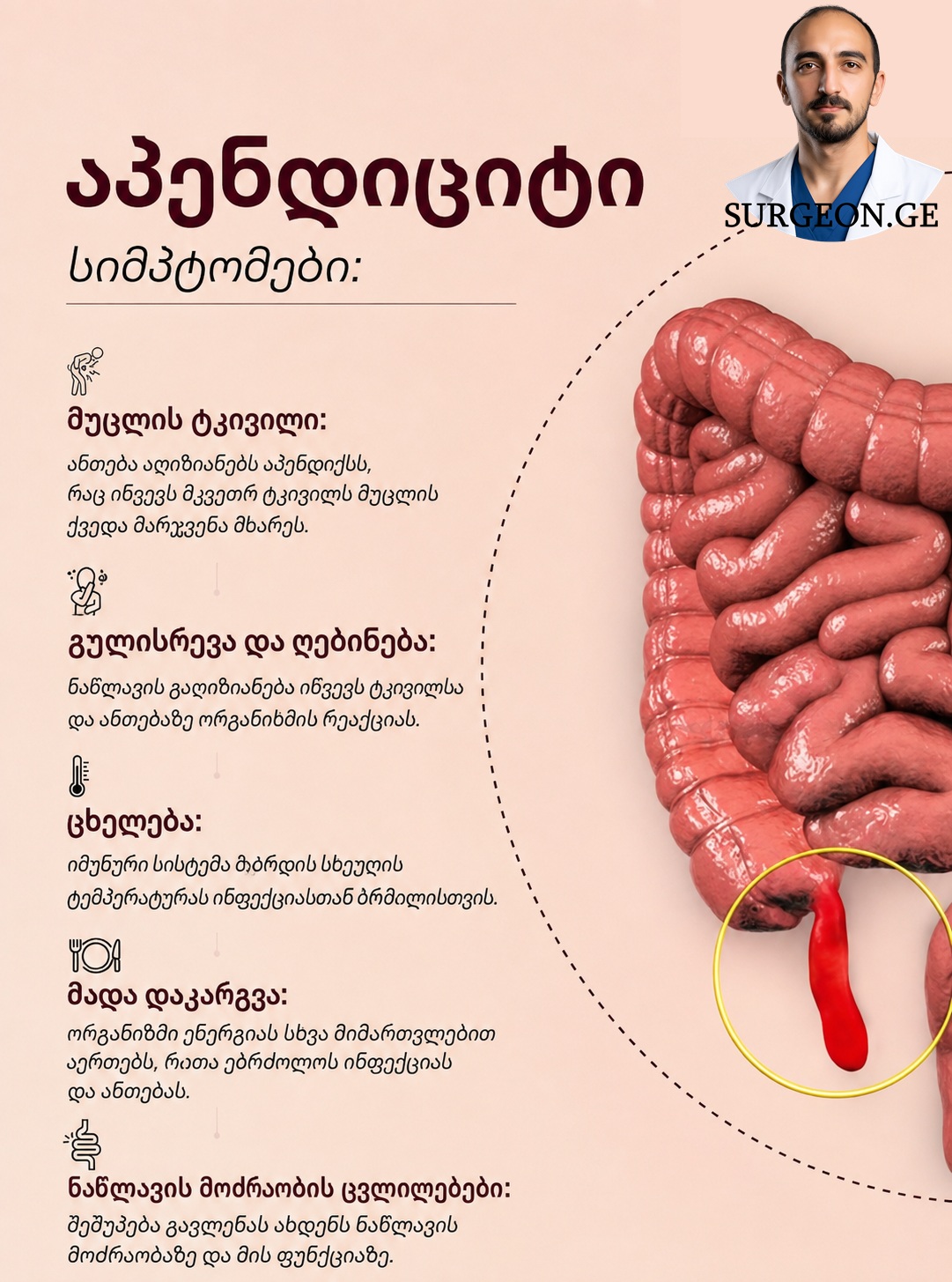
The appendix sits in the lower right side of the abdomen, where it joins the cecum — an area known as the right iliac fossa.
Characteristically, the pain first appears around the navel or in the upper abdomen and only after a few hours "migrates" to the lower right side — this shift is considered one of the hallmark signs of appendicitis.
Causes
The exact cause isn't always identified, but several contributing factors are known:
- 🧫 Blockage of the appendix — by hardened stool (a fecalith)
- 🦠 Lymphoid tissue swelling — often following a viral infection, especially in children
- 🪱 A foreign body or parasitic infection — relatively rare
- 🔬 A tumor — a rare cause
Signs and symptoms
The classic picture of appendicitis develops in stages and includes several characteristic signs:
- 🔻 Abdominal pain that gradually shifts from around the navel to the lower right side
- 🤢 Nausea and vomiting
- 🍽️ Complete loss of appetite
- 🌡️ A low-grade fever (37.5–38.5°C / 99.5–101.3°F) when uncomplicated
- ✋ Abdominal muscle tension and tenderness on palpation, especially when the hand is released suddenly
- 🚶 Pain that worsens with walking, coughing, or movement
The severity and order of symptoms can vary by age, the appendix's exact position, and during pregnancy.
Acute vs. chronic appendicitis
Appendicitis takes two main forms, which differ markedly in how they progress:
Appendicitis in children
In children, especially younger ones, acute appendicitis is harder to recognize because they can't describe the character and location of pain as precisely as adults — the picture often narrows down to general loss of appetite, fussiness, crying, fever, or vomiting, which is easily mistaken for a stomach bug.
Children also carry a higher risk of rupture, since the omentum — the tissue that helps wall off infection — is still not fully developed. This makes prompt medical attention especially important when a child has abdominal pain that persists or worsens.
Is it dangerous? What complications can occur?
Acute appendicitis left untreated is dangerous — the inflamed appendix can rupture, leading to peritonitis, a widespread abdominal infection that is life-threatening. An abscess (a pocket of pus) can also form. This is why any suspicion of appendicitis calls for immediate medical evaluation rather than waiting it out at home.
Appendicitis or something else?
Several common conditions can mimic appendicitis, especially in the early stages. A precise distinction can only be made by a doctor, based on examination and testing:
These distinctions describe general patterns and don't replace a doctor's evaluation — overlapping symptoms call for a professional work-up.
Treatment — surgery
⚠ Important warning: once acute appendicitis is confirmed, taking painkillers or "watching and waiting" is dangerous — it only masks the clinical picture and delays timely surgery, raising the risk of rupture and complications.
The standard treatment for confirmed acute appendicitis is an appendectomy — surgical removal of the appendix:
The operation is performed under general anesthesia and, without complications, typically takes 30–60 minutes.
Cost of the operation
The cost of an appendectomy depends on the surgical method (laparoscopic or open), the stage of the disease and whether complications are present, the length of hospital stay, the need for anesthesia and additional testing, and the clinic's and insurance plan's coverage terms. Because these factors are highly individual, general price tables found online are often inaccurate — an accurate figure requires assessment of the specific case and a direct consultation with the clinic.
The post-operative period
Recovery depends on the type of surgery and the severity of the disease:
- 🏥 After an uncomplicated laparoscopic operation, hospital stay is usually no more than 1–2 days
- 🩹 Keeping the wound clean is essential during the first few weeks
- 🏋️ Avoiding heavy physical exertion is recommended for 2–4 weeks
- 💼 Returning to normal activity and work is generally possible within 1–3 weeks, depending on the individual
- 🍲 A gradual return to regular meals, starting with light food in the first days
When to seek emergency care
Sharp, worsening abdominal pain accompanied by high fever, vomiting, or marked abdominal rigidity calls for immediate medical evaluation. After surgery, contact your doctor right away if you notice high fever, redness, swelling, or discharge at the wound site, or worsening pain.
Frequently asked questions
How can you tell if it's appendicitis?
The most telling sign is pain that gradually shifts from around the navel to the lower right abdomen, along with loss of appetite, nausea, and a mild fever. Still, only a doctor can confirm the diagnosis, based on examination, blood tests, and ultrasound.
Can appendicitis be treated without surgery, with antibiotics alone?
In select, uncomplicated cases, a doctor may consider antibiotic therapy, but this is an individual decision made only after medical evaluation — surgery remains the standard and most reliable treatment.
How much does appendicitis surgery cost?
The price depends on the surgical method, the disease's complexity, and the clinic's terms — a direct consultation is needed for an accurate figure.
How long does recovery take after surgery?
After an uncomplicated laparoscopic procedure, hospital discharge is usually possible within 1–2 days, with a full return to normal activity within 1–3 weeks.
Is appendicitis dangerous for a child?
Yes — especially because symptoms in children are often nonspecific and the risk of rupture is higher. Prompt medical attention is essential when a child has abdominal pain that persists or worsens.
About the author
Giorgi Shubitidze, MD — general surgeon, Tbilisi. Performs emergency and elective abdominal surgery, including laparoscopic appendectomy.
To confirm a diagnosis or discuss the cost of surgery, get in touch through surgeon.ge.
This article is for informational purposes only and does not replace individual medical consultation. If you have abdominal pain or any of the symptoms described above, see a doctor for an accurate diagnosis.
Published: · Giorgi Shubitidze, General Surgeon