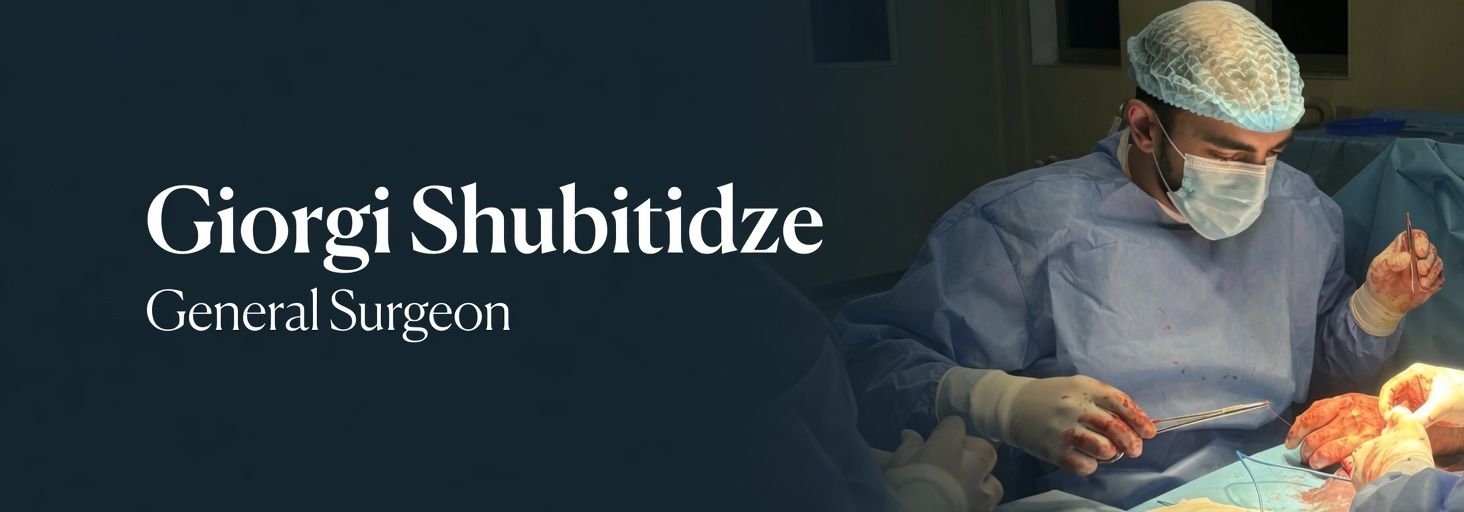
General Surgery Services in Tbilisi
I perform emergency and elective operations in line with current clinical guidelines. Operations are performed at American Hospital Tbilisi and Vivamedi Medical Center.
Acute Abdomen Surgery
Acute surgical conditions of the abdomen that require rapid diagnosis and timely operative treatment.
Acute abdomen
Diagnosis and emergency operative treatment of acute surgical conditions of the abdomen.
Bowel resection
Surgical removal of a damaged or perforated segment of bowel and restoration of bowel continuity.
Perforated gastric and duodenal ulcer
Emergency surgical treatment of ulcer perforation — a life-threatening condition.
Abdominal Trauma
Injuries to abdominal organs caused by blunt or penetrating trauma — road accidents, falls, blows or wounds. Such injuries are often associated with life-threatening bleeding and require timely surgical intervention.
Splenic injury
Control of bleeding from an injured spleen — preserving the organ whenever possible, with splenectomy when necessary.
Liver injury
Surgical treatment of liver injuries: bleeding control and management of damaged tissue.
Mesenteric injury
Control of bleeding from injured mesenteric vessels and assessment of the bowel's blood supply.
Small bowel injury
Surgical treatment of injury or rupture of the small bowel wall — repair or resection.
Colon injury
Surgical treatment of colon injuries — repair, resection and, when necessary, stoma formation.
Intra-abdominal bleeding
Identifying and controlling the source of bleeding inside the abdomen during emergency surgery.
Planned Operations
Planned operations after a preliminary consultation and the necessary tests, with an individually selected technique.
Stoma reversal (restoring bowel continuity)
Colostomy reversal
Closure of a colostomy and restoration of colon continuity, after which the bowel works naturally again.
Enterostomy / ileostomy reversal
Closure of an enterostomy (including ileostomy) and restoration of small bowel continuity.
Other planned operations
Hernia repair (hernioplasty)
Surgical treatment of inguinal and umbilical hernias.
Laparoscopic cholecystectomy
Gallbladder removal through small incisions for gallstone disease and cholecystitis.
Duration, recovery, questions →Pilonidal cyst excision
Surgical excision of a pilonidal cyst (sinus) in the sacrococcygeal region.
Removal of skin and subcutaneous lumps
Removal of lipomas, sebaceous cysts (atheromas), papillomas and dermatofibromas by minor surgery.
Laparoscopic Gallbladder Surgery (Cholecystectomy)
Laparoscopic cholecystectomy is the modern, minimally invasive method of removing the gallbladder. The operation is performed at American Hospital Tbilisi and Vivamedi Medical Center.
- Duration
- 40–90 min
- Anesthesia
- General
- Incisions
- 4 · 5–12 mm
- Hospital stay
- 1–3 days
- Heavy exertion
- After 1 month
Questions and answers
How long does laparoscopic gallbladder surgery take?
Usually from 40 minutes to an hour and a half, depending on the degree of gallbladder inflammation and anatomical features.
What type of anesthesia is used for gallbladder surgery?
Laparoscopic cholecystectomy is performed under general anesthesia.
How many incisions are there after laparoscopic gallbladder surgery?
Four small incisions: one 12 mm, one 10 mm and two 5 mm. Unlike open surgery, there is no large incision on the abdominal wall.
Can the operation be converted from laparoscopic to open surgery?
Very rarely — only when completing the operation laparoscopically is technically impossible. This has not yet happened in my practice: even in difficult cases the operation was completed laparoscopically, although it took longer.
When is gallbladder surgery needed?
Surgery is indicated for gallstones, gallbladder polyps and acute cholecystitis — including cases with neither stones nor polyps, where inflammation is caused by impaired blood supply to the gallbladder (acalculous cholecystitis). The need for surgery is determined at the consultation, based on test results.
What tests are needed before gallbladder surgery?
In most cases an abdominal ultrasound is sufficient for diagnosis. Before surgery, all patients undergo preoperative tests: complete blood count, coagulation panel, infectious disease screening, electrocardiogram and a cardiology consultation.
How many days will I stay in hospital?
It depends on the patient — usually 1–3 days.
When can I return to work after gallbladder surgery?
Normal activities and non-strenuous work can be resumed right after discharge. Heavy physical exertion, including lifting heavy objects, is not recommended for the first month.
Can you live normally without a gallbladder?
Yes, you can live a normal life without a gallbladder. Dietary recommendations after surgery are described in detail in this blog article.
Read more on the blog
Soft Tissue Injuries and Reconstruction
Surgical treatment of wounds, skin defects and tendon injuries.
Skin grafting
Closure and reconstruction of wounds and skin defects.
Tendon repair
Surgical repair of an injured tendon to preserve function.
Surgical Approach
Every surgical decision takes into account clinical indications, current guidelines and patient safety.
- Surgery only when it is truly necessary — avoiding unnecessary procedures.
- Minimally invasive approach — laparoscopy wherever possible.
- Clinical decisions based on current international guidelines.
- Fully informing the patient — before surgery and throughout recovery.
Need a surgical consultation?
In a life-threatening situation, call 112 immediately.